
Articles
Your motorcycle battery in winter: take it indoors or leave it fitted?
Nobody wants the first spring ride to start with a clicking relay. How to plan storage and charging—and why AGM and LiFePO4 need different treatment.
 fruskate
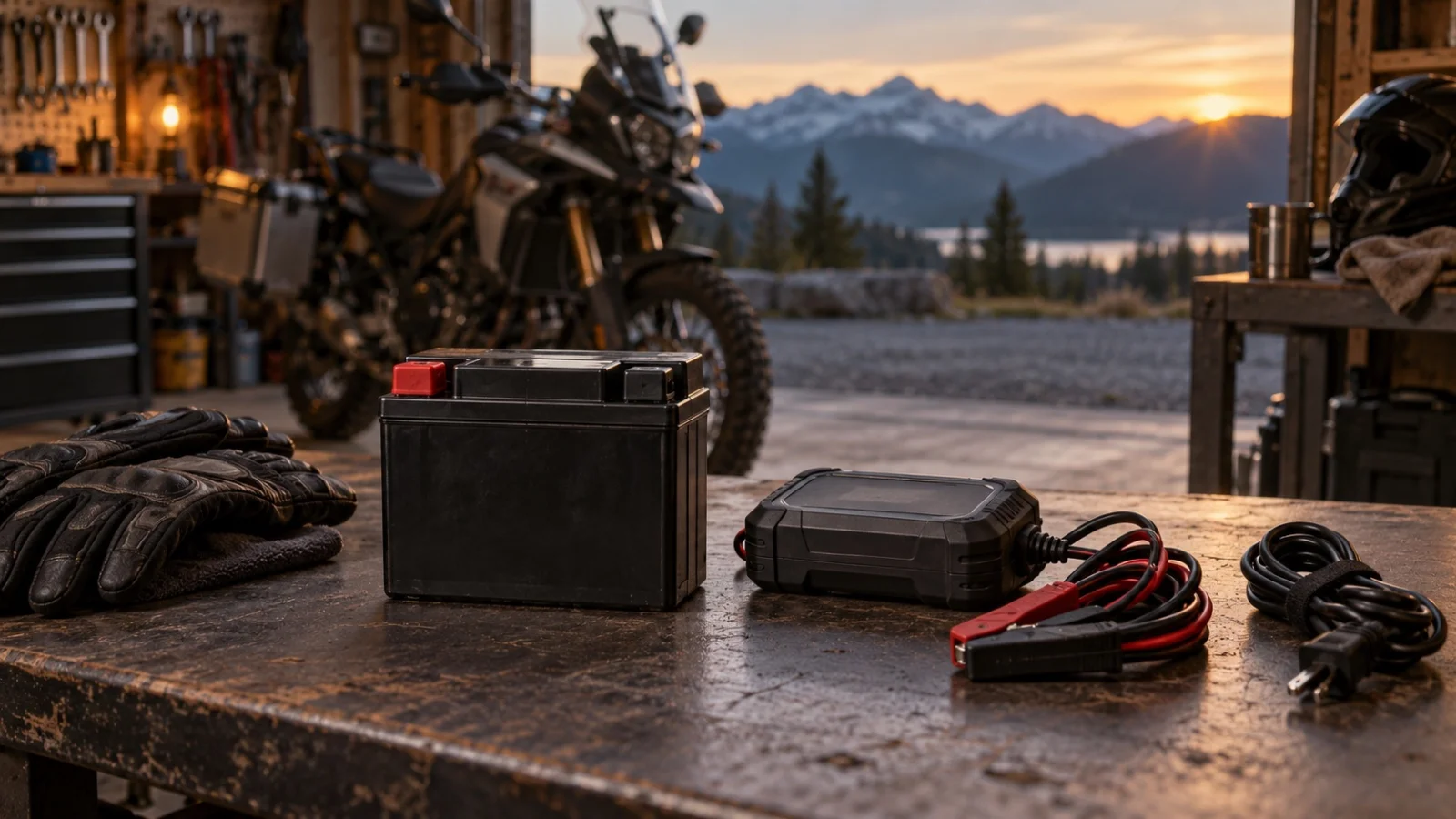
The first spring ride is planned, your gear is on, and the starter gives you a click instead of an engine. A little battery care over winter usually offers a better start to the season.
You don't always have to remove the battery. What matters is its chemistry, the storage conditions and keeping an eye on its charge. A battery on a shelf still discharges.
Read the label before choosing a charger
Conventional lead-acid, AGM, GEL and LiFePO4 batteries need compatible charging. “12 V” or “maintenance-free” doesn't tell you enough. Find the model and read both the battery and charger instructions.
Leaving a lead-acid battery discharged for a long time harms it. Yuasa advises charging before storage and checking its condition afterwards, with top-ups as needed. Follow the battery's guidance for the checking interval. Don't open a sealed AGM or add water.
A maintainer can be convenient if both manufacturers allow that use. A “smart charger” label doesn't confirm the right current, charging profile or permission to leave it connected for months.
Lithium isn't one universal charger setting
LiFePO4 needs an explicitly compatible mode. Lead-acid desulphation and repair pulses aren't suitable, and a Li-Ion or LiPo charger isn't automatically interchangeable.
Temperature limits matter too. Shorai forbids charging its batteries below 0 °C; check your own battery's limits rather than assuming a BMS makes any temperature acceptable.
Don't use a lead-acid voltage chart to judge LiFePO4 charge. If protection has shut the battery down and a charger won't recognise it, don't bypass the BMS with improvised wiring or a booster. Use the manufacturer's recovery procedure or a workshop.
Make the plan fit your garage
If you regularly visit a dry garage and can charge safely, leaving the battery fitted may be practical. If the bike will be hard to reach and its alarm or tracker keeps drawing power, removal or approved disconnection reduces that drain. Remember that disconnecting it may also disable security equipment.
Store a removed battery somewhere dry, ventilated and within its temperature specification, away from heaters. Protect the terminals. On a normal negative-earth system, disconnect the negative terminal first and reconnect it last; don't let a tool bridge the positive terminal to the frame.
Before charging, check polarity and casing condition, provide ventilation and keep flames and sparks away. Don't charge a damaged, swollen or possibly frozen battery.
Two bits of garage advice to question
“Leave the charger on all winter” works only when both sets of instructions permit it. Some LiFePO4 batteries call for periodic charging and disconnection instead.
“Start it for five minutes” isn't a reliable charging plan either. Starting uses energy, and a brief idle may not put it back.
Record the battery model, charging date and checks. If it loses charge quickly again, investigate the battery, charging system and key-off draw. Buying a new one every spring gets expensive without fixing the cause.
The rest of the winter jobs are in the storage checklist. You can compare model-specific experience with other owners in MotoASIA.