
Articles
Why do your eyes get stuck on the edge of a motorcycle corner?
A bend feels tighter than expected and the road edge takes all your attention. Work on entry speed and your view of the route, rather than chasing lean angle.
 fruskate
The corner is tighter than you expected. You notice the road edge, and suddenly it is the only thing you are looking at. There may still be a manageable route through the bend, but little of your attention is left for it. That is target fixation: your eyes stay on the thing you want to avoid.
“Look where you want to go” is useful advice, but it is not magic. You also need a suitable speed, control inputs and an available path. Turning your head alone cannot correct excessive entry speed or create more tyre grip.
Choose the pace before entering
As you approach, assess the visible part of the bend, the surface and oncoming traffic. Slow early and leave the ability to stop within the clear road you can see. Even a familiar corner may have changed after rain, roadwork or loose material arriving on the surface.
Do not borrow the pace of the rider ahead. Your view, motorcycle, load and experience may be different. If every entry involves catching up and feeling alarmed, “just lean more” does not address the problem. Reduce the overall pace and work on the skill in a lesson.
Look ahead without ignoring what is near
Move your attention along the route you intend to follow rather than holding it just beyond the front wheel. As the bend opens, keep updating the picture: where the lane leads, what is on the surface and whether traffic has appeared.
You do need to notice a pothole or the road edge. Staring at it for the rest of the corner is the problem. After identifying a hazard, bring attention back to an available clear path. That does not mean ignoring obstacles or staring blindly into the distance.
Let your head and eyes move, avoid rigid arms and keep feet on the pegs. Learn the actual steering and control skills with an instructor. Your eyes direct attention, but the motorcycle still needs you to operate it.
Keep the whole path in your lane
A public road does not provide space for a racing line. Do not cut into the oncoming lane or crowd the centre line. Consider the position of the leaned motorcycle and your body, not just the tyre contact points.
Leave room from the edge, approaching vehicles and anything still hidden. On wet or dirty surfaces, smooth inputs matter even more. Braking while leaned requires separate instruction; do not explore its limits on a road.
Practise a calmer corner
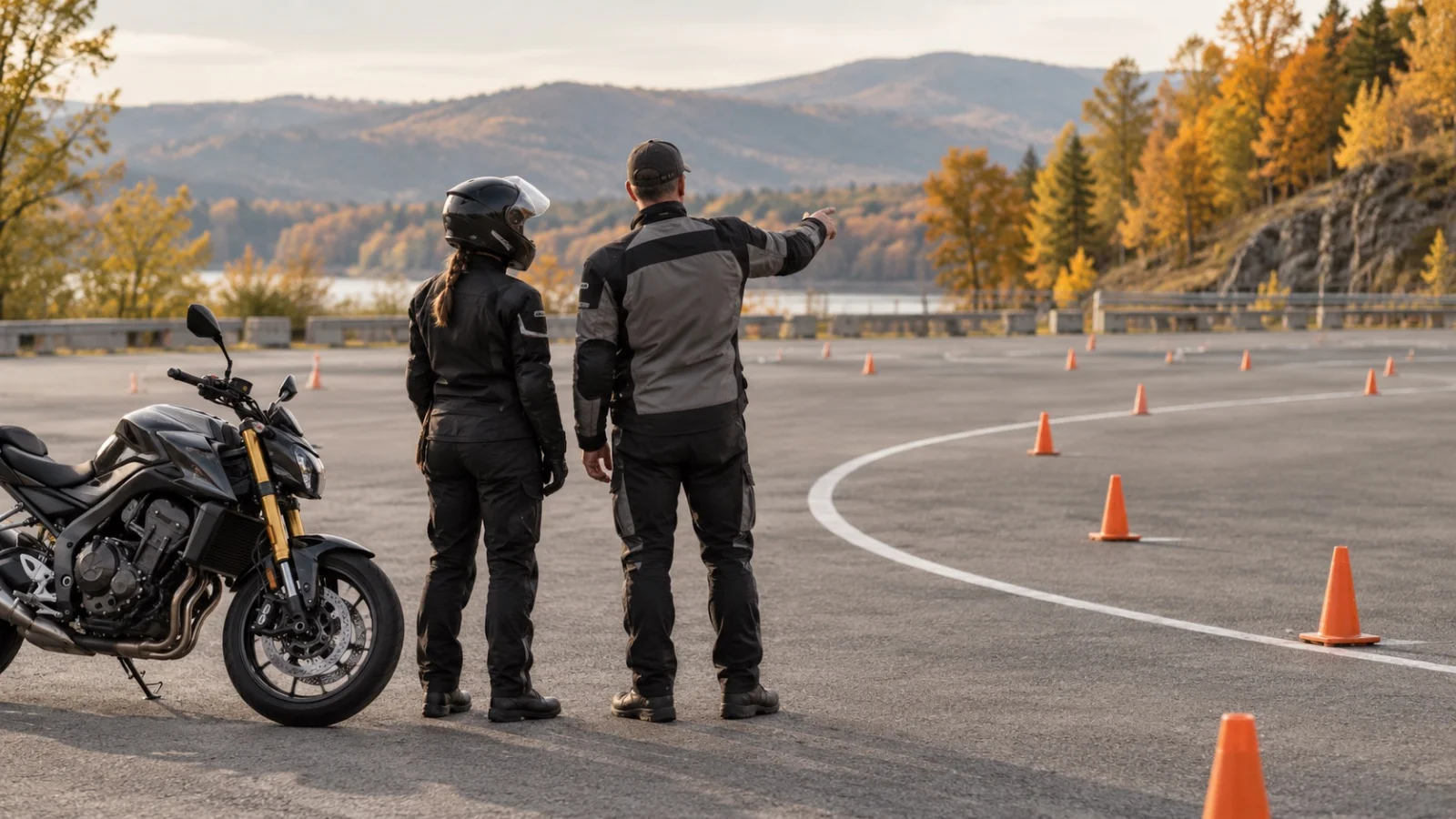
In a closed training session, ask the instructor to watch your speed choice, looking habits and arm tension. Start with an uncomplicated curve at a comfortable pace. The goal is a repeatable turn without alarm, rather than a dramatic lean for a photograph.
If several bends leave you increasingly tense, stop safely, rest and simplify the route. A useful corner leaves enough attention and room for the next one.